

Active ingredients are only half the story
The science of why the base technology, and not just the actives (or their percentages), decides what your skincare formulation actually does.

Somewhere along the way, the internet decided that skincare is purely a numbers game. Well, on some level, yes, it is - because chemistry and biology have a lot of math in it. But recently, the internet discourse has stripped off the formulation science - 30s reels have trained us to follow a uniform code - find the percentage → scan the label → pick the product with higher concentration = because it will be more effective.
On the surface, it sounds rational, like reading a nutrition panel. And to some level, it is even true - certain active ingredients deliver the best results only at a certain concentration.
But relying on the concentration of the active ingredients is a very reductive approach to evaluating the effectiveness of a product.
The percentage tells you only one thing: how much of that active ingredient went into the final product. It tells you almost nothing about how much of that active ever reaches your skin, or how it interacts with the rest of the ingredients.
What decides the gap between them is the base - the vehicle that carries the active ingredients and makes sure they get absorbed into your skin to deliver results.
Think of your formulation as a vegetable soup. The broth is the base and the active ingredients are your vegetables. If you overcook the broth, the veggies become mushy and lose their texture and nutritional value. If the broth ends up becoming too spicy, you get the veggies as intended, but give yourself a case of acid reflux in the process. Similarly, if your base technology (or base) is not compatible with the actives, or uses other incompatible ingredients, you’re not going to benefit from fancy actives or percentages anyway.
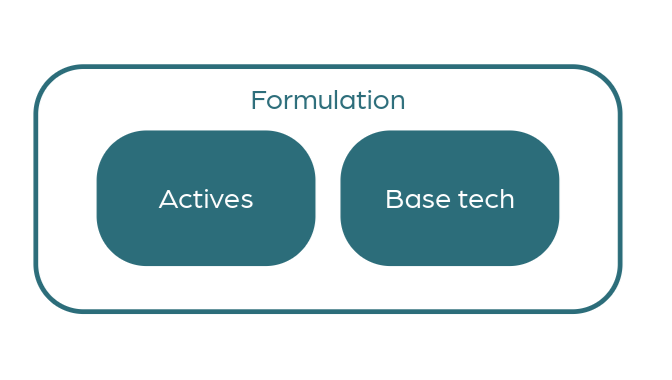
Two products can have identical ingredients in identical amounts and still behave like different products, because the base technology is different.
For example, L-ascorbic Acid is the pure, active form of Vitamin C - an antioxidant that fights oxidative stress and supports collagen production.
L-ascorbic acid is stable and easier to absorb in the skin when the formula is acidic (below a pH 3.5). Raise the pH and absorption falls off steeply (and it browns in the bottle sooner, too). So you can have the same 20% printed on two labels, one at pH 3 and one at pH 5, but the second one will showcase lower absorption.
Note: Traditional L-ascorbic acid requires an acidic pH (typically below 3.5) to remain stable and effectively penetrate the skin. However, newer vitamin C derivatives like Ethyl Ascorbic Acid or Tetrahexyldecyl Ascorbate are highly stable and can be formulated at higher, skin-neutral pH levels.
A Bad Base Can Make Things Worse
A poorly formulated base technology does more harm than simply limiting the efficacy of an active ingredient. A cleanser with the right actives but harsh surfactants (instead of milder ones) can strip your skin dry. A potent serum with no buffering ingredient can irritate the skin, leaving it raw. And a moisturizer with comedogenic occlusives (instead of lightweight, non-comedogenic ones) can clog your pores, causing breakouts.
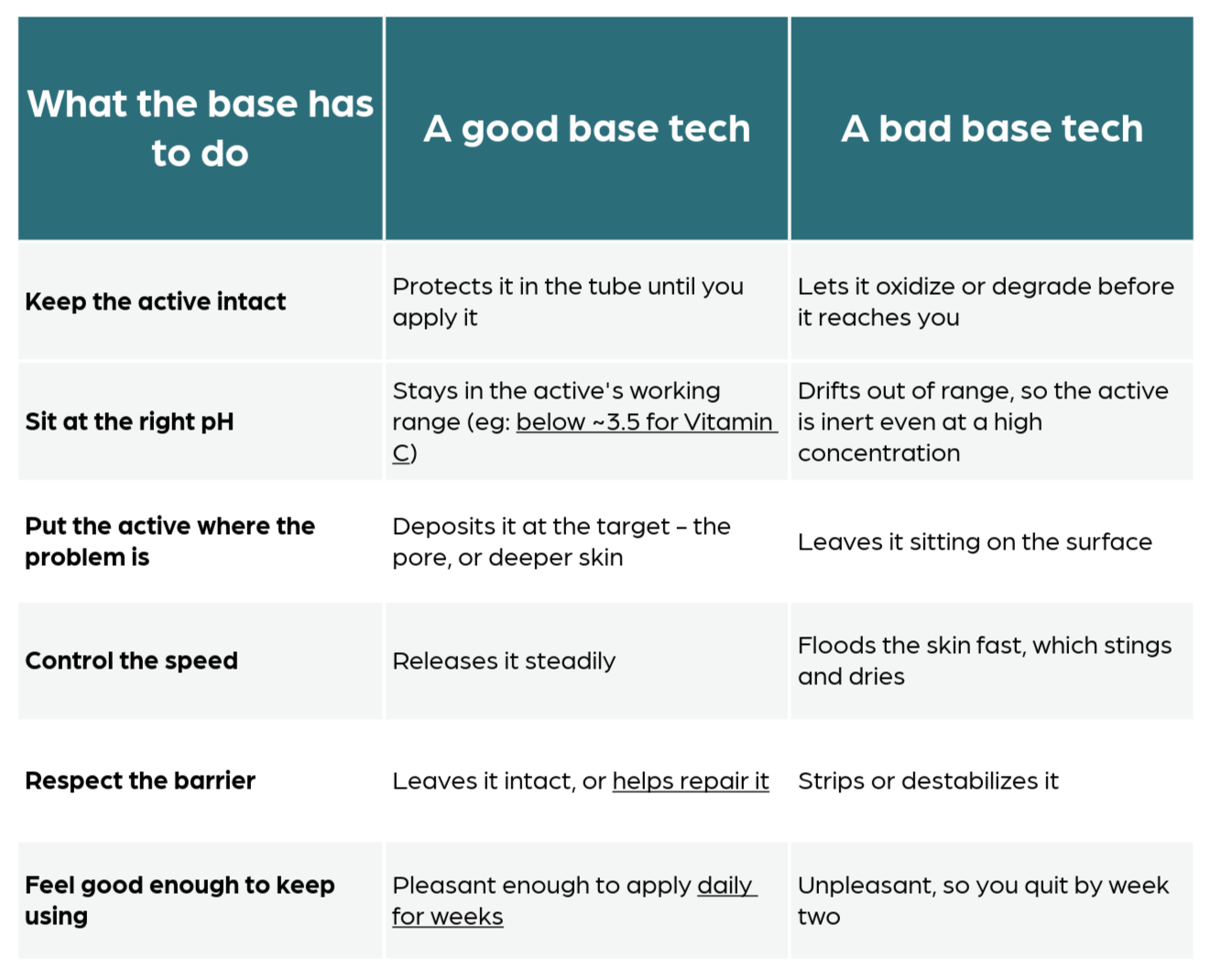
Difference Between A Good Base Technology And A Not So Good One
So, What Should You Evaluate In A Formulation?
While I’ve broken down why the base technology is important, do remember that a brilliant base cannot rescue the wrong active. Delivery is the other half of the equation, not a replacement for it.
But, instead of only asking “what’s the active and what % is there,” also ask: what’s the pH, what form is the active in, and is there any proof it actually reaches your skin?
Stop only relying on the percentage. Look at the complete picture.